Articles
Why CMMC Compliance Matters for Defense Contractors
CMMC has quickly become a critical topic for defense contractors navigating today’s procurement environment. With new requirements taking shape and expectations rising, contractors are seeking clear guidance on what compliance really means and how to prepare without disruption.
In this video, Sean Doherty, CEO of GovDash, sits down with Max Aulakh, President & Founder of Ignyte, to break down what this shift actually means for defense contractors and the software vendors they rely on.
The Compliance Landscape Has Changed Permanently
Defense contractors are operating in a fundamentally different environment than even a few years ago. As of November 10, 2025, CMMC is now a reality that all defense contractors have contend with. These requirements are active, enforced, and tied directly to eligibility for work. The shift is intentional. The government is modernizing how it protects sensitive defense information. Contractors treating compliance as a box-checking exercise are already behind.
Improving the security posture of the defense industrial base rests at the core of CMMC. Covered Defense Information and Controlled Unclassified Information (CUI) are now subject to additional regulation, impacting software procurement, IT operations, and information security practices for defense contractors.
Does CMMC apply to subcontractors?
CMMC doesn’t just apply to prime contractors; sensitive information needs to be protected everywhere it lives. Subcontractors who process, store, or transmit FCI or CUI must be CMMC compliant and cannot be awarded work without a prime contractor verifying compliance.
Prime contractors are responsible for ensuring CMMC compliance throughout their supply chains, regardless of a vendor company’s size. This compliance must be achieved through a formal process to verify subcontractor compliance with CMMC. Failure to satisfy CMMC requirements could result in sanctions and penalties, including False Claims Act settlements or ineligibility for new awards based on the DFARS CMMC clause.
For Defense Primes: Learn how GovDash teaming can be used to keep track of CMMC compliance across subcontractors and partners. |
Subcontractors must meet the CMMC level specified in the prime contract, and primes should verify compliance before awarding any work that involves FCI or CUI. A documented supply chain process should map where FCI and CUI flows, ensure DFARS requirements are flowed down, and validate compliance through current certification or other contract-permitted evidence. Subcontractors that cannot demonstrate the required level may be excluded from the scope, and supply chain gaps can put future awards at risk and increase exposure tied to inaccurate compliance representations.
Why Compliance Matters in Defense Software Procurement
CMMC is a broad requirement that involves nearly every aspect of an organization’s information systems. That includes capture tools, proposal platforms, contract management software, and CRMs. Software where sensitive data lives and moves needs to be secured. That is why the government increasingly cares about where data is hosted, who has jurisdictional control, and whether vendors have been independently assessed.
Commercial cloud environments and vendor self-claims are no longer sufficient. You cannot grade your own homework. The government expects third-party validation to establish trust across the ecosystem. For contractors, this means software choices directly impact audit outcomes. The wrong vendor can stall or even derail certification.
FedRAMP® and CMMC Serve Different but Connected Purposes
FedRAMP and CMMC are often lumped together, but they solve different problems. FedRAMP is product-focused: it certifies that a specific SaaS offering meets strict security requirements within a defined boundary. CMMC is corporate-focused. It applies to the entire organization and is tied to the contractor’s CAGE code.
Both matter. A secure company running insecure software still fails. Secure software inside an insecure organization also fails. Contractors need alignment between their internal controls and the platforms they rely on. Vendors that understand this distinction and invest accordingly become enablers, not risks.
Timing Matters, and Most Contractors Are Late
As CMMC requirements are being incorporated into solicitations as conditions of award, the window for preparation is closing quickly.
One of the fastest ways to reduce friction is to use technology that is already credentialed. FedRAMP Moderate equivalency is now a minimum requirement for any SaaS platform handling CUI. Vendors that are not on that path are actively slowing their customers down and, in some cases, forcing expensive platform migrations mid-growth.
How Do You Know If A Software Vendor Is Ready for CUI and CMMC?
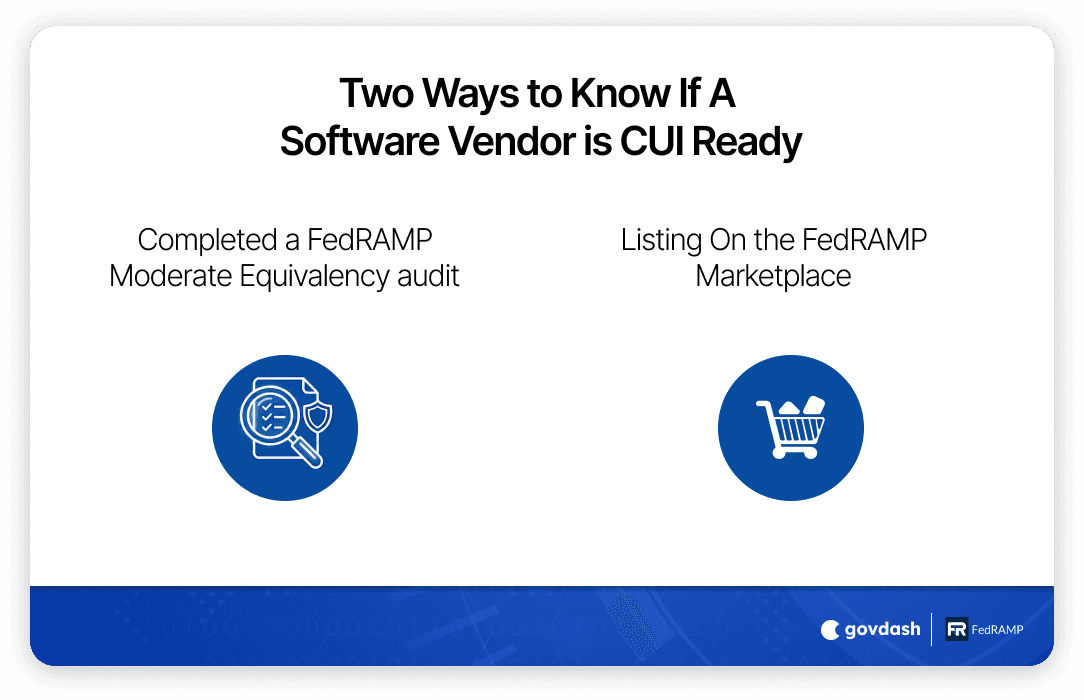
FedRAMP® Moderate Equivalency and the FedRAMP® Marketplace are equally acceptable recognitions of security. To check whether a vendor is ready for CUI, start by confirming either:
(1) The product is listed on the FedRAMP Marketplace as authorized at FedRAMP Moderate or higher, and the listing matches the exact offering you will use, or
(2) The vendor can provide a FedRAMP Moderate equivalency package with a Customer Responsibility Matrix (CRM) aligned to Moderate controls, recent independent assessment evidence, and a clear continuous monitoring plan in partnership with a FedRAMP® Certified Third-Party Assessor Organization (C3PAO).
What Contractors Should Demand From Their Software Vendors
High-assurance security is no longer a differentiator. It is a requirement. Contractors are already walking away from multi-year software contracts when vendors cannot support their compliance journey. The message is clear. If your tools are not secure, your contracts could be jeopardized.
CMMC is about continuing to do business in the defense market. Contractors that take it seriously and choose partners who do the same will move faster, win more work, and stay eligible as the rules continue to tighten.

GovDash adheres to FedRAMP Moderate Equivalent standards, including monthly continuous monitoring. It is capable of handling CUI and CDI for CMMC customers. |